|
Conducting experiments in space has been a
great adventure in my career. In the early 1990’s we were growing
crystals from fluid solution in the microgravity of space and we
needed to observe the fluid motion around the crystal. I suggested
an old trick of placing neutrally buoyant particles in the fluid and
observing their motion. Needing the help of a fluid mechanics expert
who could tell us exactly how well the particles could track the
fluid movement, I called on an old friend, Roger Rangel, a professor
at the University of California, Irvine (Now a department head). The
movement of particles in fluids can be predicted from the so-called
Navier Stokes equations. The problem is that these equations have
never been solved exactly, and scientists employ approximations and
what are known as numerical solutions provided by long computer runs
to get answers. An exact solution would look somewhat like the
following, which is essentially Newton's second law of motion, every
action has an equal an opposite reaction.
Newton's Second Law of Motion
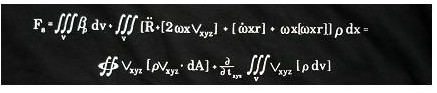
The primary problem with such a solution is
that it still has a lot of mathematical terms in it that so not
provide a clear physical meaning. That is, it is not yet a usable
solution without further work and approximations to break it down to
more usable form. Specifically solutions to the Navier-Stokes
equations contain an extremely complicated “history” term that look
roughly like the last terms in the above equation..
Carlos Coimbra, a brilliant, young Brazilian
student of Roger’s (now a professor at the University of Hawaii),
was assigned to work with us on the program. Carlos, in addition to
being a mechanical engineer, is also a very adept mathematician, and
was familiar with fractional differential equations, a little-known
branch of mathematics. After working with the problem for some time
and running a series of numerical computer solutions, Carlos
suggested that he might be able to solve the equations exactly,
using fractional derivatives. Not withstanding the fact that
scientists have been trying to do this for more than a
century, Roger encouraged Carlos to proceed.
To make a long story short, by rewriting the
equation in the language of fractional derivatives, Carlos
transformed it into a standard equation type that is easily
solvable. As often happens when a scientific equation is solved
exactly, many doors are opened and new knowledge and phenomena are
discovered. In fact, this new solution described, very simply, a new
force in nature that would be proportional to a one half derivative,
a very exciting finding for physicists, who love finding and
labeling new forces.
The new solutions provided us a new and better
understanding of the Navier-Stokes equations, especially how they
operated in the absence of gravity. In fact, they alerted us to a
number of rather astonishing phenomena that would be observable in
the microgravity of space, phenomena that had never been seen on
earth because gravitational effects had masked them. If Carlos’
solutions were correct, then we would, indeed, have a handle on all
parts of the Navier-Stokes equation.
With great enthusiasm, I proposed to NASA a
series of spaceflight experiments that would allow us to look for
these phenomena in space, to observe this new force in action, and to further test the validity of the
famous Navier-Stokes equations. NASA scientists, being equally
enthralled, agreed in the scientific importance of the quest and recommended
that such experiments be conducted on the Space Shuttle. The project
SHIVA was born. SHIVA (Spaceflight Holography Investigation in a
Virtual Apparatus) would apply holography in space to track the
movements of particles in a fluid in three dimensions, and would
uncover the effects of the famous history term. The acronym, SHIVA,
had a second meaning. Shiva, the Indian god, is known as the
destructor, destroying the old and making room for the new. We were
going to do that as well.
Many obstacles to making such critical
measurements in space had to be removed. We had to prove that the
equipment would survive launch, be acceptable on the Space Shuttle,
and produce the necessary measurements without taking up excessive
amounts of astronaut time. Over the next five years, the SHIVA team
of scientists and engineers from three universities and NASA
designed, constructed, and tested the required apparatus that would
fly on the Space Shuttle. After many experiments, design projects,
conference calls, and reviews, we satisfied all of criteria set by
NASA for flying an experiment in space, and we were ready to build
the flight apparatus.
Our first major setback was the Columbia
accident, which put all experiments on hold. And then a year later
President Bush made his “New Space Initiative” announcement that we
would go to Mars, changing the entire NASA apparatus and goals.
Effectively, money needed for such an adventure killed all other
space flight experiments. SHIVA was one of the last cancelled to
provide money for the Mars venture. Fortunately, we were given
another year to close down SHIVA. In that year we continued to work
in our ground laboratories, improving our measurement accuracy more
and more until we were finally able to observe and to measure many
of the effects that would have been easily seen in space.
Terminating SHIVA was devastating to the many
scientists, engineers, and technicians who had devoted years of
their careers in preparing for the experiments and who were hoping
to see the results of their labor.
Several years after SHIVA had been terminated I
was working at the National Academy of Sciences in Washington D.C.
on a committee to provide advice on spending $150,000,000 to
commercialize technology. During a break I wandered into the academy
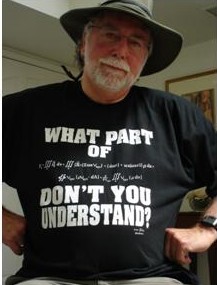
gift store and came face to face with a mannequin wearing the
T-shirt shown in the figure. My first impression was that it was a
cute take off on the normal saying of “What part of ‘no’ don’t you
understand?” And then I looked at the equation more carefully. In
words I saw the T-shirt asking me “What part of the Navier-Stokes
equation don’t you understand?” The universe had just
presented me once again with the question SHIVA answered, this time on a
fifteen-dollar T-shirt. And I can answer categorically there is NO
part of the equation that the SHIVA team doesn’t understand, and we
have proven it……….sorta. Moreover, I know a Brazilian guy out in
Hawaii who can tell you even a lot more about it.
|

