|
|
|
Portrait of Saul Bryanston-Cross Hologram on Agfa Glass Photographic Plate, 22"X24" By Peter Bryanston-Cross 1993, No. 1 of 3. Gallery of J. D. Trolinger Provenance: From the artist in August, 2002 Produced at Richmond Holographics, London, UK With assistance of Edwina Orr Doubly-exposed, ruby laser, holographic interferogram 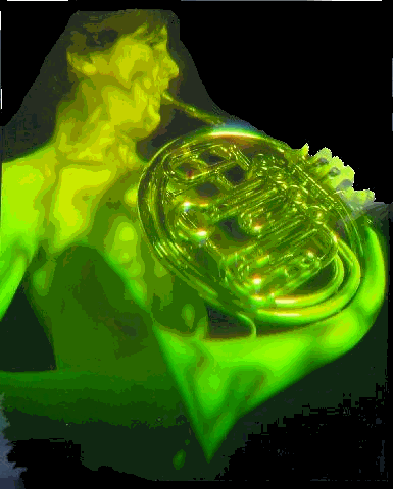
Saul Bryanston-Cross, 13 year-old (in 1993) son of the artist, is a natural and highly talented musician and composer, one of those rare individuals who can pick up an instrument, like this French Horn, and immediately produce pure notes, with no overtones. When asked how he knows that the note is in its pure form, his response is "I can feel it." This piece is highly successful in exploiting the medium of holography to capture and convey to a sophisticated (trained) observer information, meaning, and emotion that cannot possibly be achieved with photography, painting, or even sculpture. As such it is a highly successful work of holographic art. The photograph shown here is a mere representation of the actual piece, which must be viewed to study, enjoy and participate with its many features. The ability to capture and display parallax (providing different images and information when viewed from different angles) is a principle feature of holography. Viewer interaction is another. Parallax is, of course available in sculpture, but not in painting or photography (except for stereo photography, where it is still severely limited). The artist makes a very effective parallax-enhancing use of shadows in this composition, a technique known to and used often by seasoned art holographers. Shadows produced by the French horn on Saul’s body move in relation to the part of the horn that creates them when a viewer changes his head position, greatly enhancing and encouraging viewer participation with the piece. The bell of the horn protrudes over a foot in front of the hologram. The artist has chosen to place the face in the plane of the hologram, usually a wise choice in holographic portraiture because of limitations in lighting used during viewing. The artist, Peter Bryanston-Cross, one of the most creative scientific holographers of the 20th Century, realizing that his son’s "feeling" might be made observable through the application of holographic interferometry, produced this holographic portrait that displays visually and quantifies, to the trained eye, the feeling process described by Saul. The fringes in the horn show how the sound vibrations move the horn, displaying visually what we would have heard if we had been there during the recording. Even an untrained observer can connect the patterns to sound without much imagination. We are effectively seeing the movement that is causing the sound coming from the horn, the same sound that can be heard by the musician, and also the sound trapped in his bones and felt by his body. Recording two superimposed, minutely different images of an object with holography enables the display of the separation of the two object positions. Such recordings exhibit contour fringes that can detect and display minute movement a subject caused by sound vibrations. From the scientist’s view, a strong resonance can be observed through the fringes in Saul’s collarbone, facial structure, and chest wall. His bone structure, acting like large sound antennae, conveys information to his brain that his ears cannot. The resonances would be felt strongly by him when certain resonant frequencies are achieved, and he would be able to detect easily any overtones present in his bones if he "listens" with his body. Ears are designed to listen in a completely different way and could not provide the same type of information. This unique piece displays a strong interaction of science, music, and art, employing vocabulary from each. We can share sound and feeling of the music without a sound from the picture. The hologram literally sings to us through fringes. In addition to a strong technical message, the piece offers a strong artistic, moral message. "I Can Feel the Music" is about communication between a boy and his father and the effort and training required by both to communicate in a meaningful way. What the son feels can go completely unknown to a father who is not willing to go the extra mile. If the father listens, believes, asks questions, and strives to understand, then the rewards are great. Here the father demonstrates to his son that he can hear him in ways that he may not understand, since understanding may require him to use language and knowledge of his own that may be completely foreign to the son. This work of art is a testament to the richness of information that can be conveyed between any two individuals whose goal is communication and whose strategy involves trust and employs whatever tools and language they command. The piece also implores us to listen to our own bodies. The technical quality of the hologram is excellent, exhibiting a bright low noise image of high resolution. Much of this can be attributed to the production of the piece in Richmond Holographic Laboratories, where the latest in recording technology and chemistry were available. Only in such a highly advanced laboratory could a hologram of this quality be produced. This work of art is also a testament to teamwork, pushing the limits in pulsed laser holography and processing chemistry. In the actual piece an observer can count the hairs on the musician’s head, can focus and examine in microscopic detail over a depth of over two feet, much more than can be achieved in this simple photograph, which is only representative of a single viewing angle and depth. The image is viewable over a wide angle, allowing several viewers to examine and discuss the piece simultaneously. Holographic artists have a fairly wide range of color choices in a monocolor piece of this type through processing techniques. Artistically, it is extremely important to choose a color that is harmonious with all of the key items in the work. Here, the color choice has not only matched the gold of the French horn, but somehow gives the impression of a pleasing skin color. One of the major problems in this type of portraiture is finding a skin color that compliments the person, since full-color holographic portraiture is still rare even today. Available colors usually do not compliment the person. Providing an acceptable skin color seems easiest with a black model; however, placing the French horn in the scene with a young boy, leaves the viewer with a perception that the skin color is complementary and even flattering. This hologram introduces a green tint in the lower left hand corner of the hologram that seems to move the skin color in the correct direction, while giving the highlights on the horn a definite gold appearance. Even Joseph Albers would have been impressed with this artist for achieving this pleasing effect. Brief Summary "I Can Feel the Music" is an exceptionally strong art work because it is so rich in almost every aspect of art holography. It will be recognized in the future as a rare masterpiece and a unique example of holographic art for numerous reasons. Here are some of those reasons. It contains an aesthetic subject with deep meaning about a relationship between a father and son presented in an unusual manner. It contains deeper meaning about society in general. It exploits the medium of holography to produce effects that could be obtained in no other fashion. It is of a rare genre that combines advanced scientific knowledge with artistic creativity using complex vocabulary of both. It is of high technical quality. Only three copies exist, and since it is produced on a material that has not been available since the late nineties, no more copies will be produced. It cannot be counterfeited. It is unusually large for holographic portraiture. It is associated with a unique production team that included a highly reputable holographic laboratory and a scientist/artist who is well known and widely published. The team spent many hours conceiving, composing, and producing this hologram. It is interesting and easy to view, to participate with, to analyze, and to discuss. "I Can Feel the Music" was exhibited in the Bremen Focke Museum in 2001. Interestingly enough, an art professor, upon studying this piece for a while commented that this was only a three dimensional image and could not be considered art. It is truly amazing how little someone sees when he refuses to look. At some time in the not too distant future "I Can Feel the Music" will be a highly prized piece in the permanent collection of a public gallery. The remaining copies are in possession of the artist.
Carmenza Dominquez, a Colombian artist, produced this limited edition of 300 pieces. At first glance the piece appears to be a simple, abstract collection of glass objects stacked in a cluttered array. But further examination reveals this to be an extremely complex and profound work of art. This is not simply an accidental arrangement of glass nor a design that could have been thrown together without extensive thought, planning, knowledge of the tools of holography, and probably several attempts before making it all work. In this piece she throws out a challenge to other art forms by creating a scene that is impossible without holography. It cannot be replicated with painting, photography, or even sculpture. If viewing original art is important with paintings, it is absolutely vital with some holograms, especially this one. The photograph provides a mere hint of what is included in the overall work, which does an excellent job of exploiting the medium of holography. This photo is merely a guide for the discussion of the holographic image, which must be seen to make the discussion finally meaningful. I will attempt with words to describe the trick that Dominguez has played on us, since it cannot be done with photography, painting or any other medium. The piece speaks with the vocabulary similar to that of pop art, but is really unlike any of the isms in art. The artist has divided the subject into two regions of blue and yellow. The soft blue soothing upper background and yellow lower background combine to form a green, which is not distinct in the photograph. Color saturation and brightness is another unique aspect of the hologram that can only be seen by observing the actual piece, and the bright pure colors seen in the actual hologram give the viewer a "feel" of a special aura and “softness” around the scene. A viewer will immediately sense that the source of the light is within the hologram itself, like colored candles buried within the hologram. Color in holograms requires special skill, which varies greatly between producers. The color in this piece is simple but works extremely well because of the subject matter. The glass pieces appear transparent and nearly colorless. The sphere in the middle appears “smoky” giving it clearer definition. Dominquez has chosen the fundamental sphere, cube, triangle and cylindrical shapes to give the viewer a sense of comfort and familiarity; without these the viewer would be lost.The cubes are produced from laminates, which give them more dimensionality and allow the viewer to seek different perspectives on the cube. In some angles, one can see through the cubes, while in others he cannot. There is no left/right symmetry. For the most part, straight lines form the piece. However, adding curves to the pieces on the right breaks this rule. These curves illustrate the distorted views that occur from different perspectives. A number of triangles refer back to the symbolism of medieval art. The hologram has been produced on Agfa Gavaert emulsion on glass, a material that is no longer commercially available. The technical quality is adequate but not superb. The hologram lacks in brightness, possessing a less-than-normal diffraction efficiency. The bleaching process used in this hologram appears to be from an earlier generation, possibly explaining the dimness of the image. The scene can be viewed over about a 30-degree angle so only two or three people can view it at one time, which is unfortunate since it is an excellent image to be discussed by several viewers. A kind of symmetry about a horizontal line seems to exist. But a closer look reveals a troubling failure of the symmetry, a kind of anti symmetry, something like one might see in an Escher painting, images that cannot exist in a real world. Holograms can achieve in three dimensions what these “Escher” drawings only suggested. They can create images that sometimes are difficult to handle by our neural-visual system. The images in the upper half of the hologram are of this type. They are called pseudoscopic images of the items in the bottom half of the picture. The two images are called “conjugates” of each other. Sometimes one is called “real” and its conjugate is called “virtual”. The “real” image actually sits in front of the hologram. Pseudoscopic images are what the bottom objects would look like if one could go around and look at the front side while standing behind. Their perspective is reversed and they are “inside-out”, and the one is upside down relative to the other. What the bottom figure tells us is closest to us, the top figure tells us is farther away and vice versa. So, when the brain attempts to interpret them, error signals appear, sometimes so severe that the brain refuses to interpret them. This can even have a “dizzying” effect on some people. Putting pseudoscopic images beside their real counterparts makes the effect even more confusing. Dominguez was kind enough to choose simple figures where the effect is more intriguing than overbearing to the viewer. Most artists discard the pseudoscopic image. Dominguez has used this aspect of the medium in a striking manner, making a powerful statement. She has arranged these images so that some of the images and their conjugates overlap, producing a complementary effect. Others are separated. The psuedoscopic image typically is upside down, will appear separated from its conjugate unless it is centered in the field. She has placed all of the possible configurations here, with some overlapping, some in the hologram plane, some in front and some behind. Producing the hologram so that both images reconstruct in the same space like this is not something an amateur could do. The piece speaks of communication, understanding, taking risks, and living life on the edge. She has placed two worlds, a “virtual” world and a “real” world side by side to coexist in the same space and they attempt to communicate in a middle ground. One can feel the excitement of venturing into the virtual space and trying to interpret it, always having the comfort of the real space nearby to rush back to for comfort. One could look at this piece for many hours without understanding the virtual world it contains and how it relates to the real world. The information is there but the communication and resolution of the two worlds must be left to the viewer. The viewer must bring some knowledge of pseudoscopic imagery to the piece to fully appreciate it. Viewing this piece will have vastly different effects on different viewers. Many viewers will look at it without ever realizing a mystery exists. Others will realize that a mystery lies within, but will not be able to grasp what it is. Such a viewer can enjoy looking at it, simply because it makes him feel something he cannot understand. A viewer who brings some knowledge of pseudoscopic imagery with him to the piece can spend much time identifying the pieces in the puzzle and seeing which piece belongs to which.
Three
Star Trek Figures contains
three different, separable, Star Trek figures, a Borg, a Klingon, and a
Ferringi. This is like a
triptych, but holography allows all three images to be recorded in the
same space (multiplexed) and to appear sequentially as one moves his
point of view (or the light source) from left to right. Fine art critics
are not likely to acknowledge this piece as art at all since it can be
purchased in science stores for a few dollars. But oh, what a mistake!
The three images are represented here as three separate
photographs, which of course, destroys the significance provided by the
hologram. Photographs can
be used only to instruct one in viewing and interpreting the work. The
hologram must be viewed to even begin experiencing the work. The artist has used
the medium brilliantly, forcing three aliens who are totally
incompatible with each other to share the same space, a significant
humanitarian statement in itself. Where
better than the make-believe world of Star Trek, could the artist have
gone to find three beings who so obviously do not belong in the same
space? In the Star Trek world these men are clear enemies from different
universes. The artist is
relying on the viewer to bring this information to the picture. The implications are extensive. The
technical quality of the hologram is excellent providing three bright,
clear, completely separable three-dimensional images that can be viewed
by moving one’s point of view from left to right. The brightness and
quality of the images are made possible by use of the state of the art
material, a Dupont Photopolymer. Actually, many more than three images
can be experienced, since a kind of morphing occurs in the space between
the separated images where the left eye sees one creature and the right
eye sees the other. Depending
on the viewer, the creature’s appearance shifts constantly from one to
the other in this middle zone. At
some point, half of the face is one creature and the other half is
another. Three
viewers standing side-by-side looking at the piece will see three
totally different races, and yet each can argue that HE sees what is in
the hologram. This is a
wonderful example to illustrate how different viewers can interpret the
same space so differently, even as different worlds, from different
points of view. Only if we all communicate can we ultimately reach
something closer to the truth. Here seeing is not believing. Holography
demonstrates this more directly than would be possible with any other
medium. Three eyewitnesses
could identify any number of characters in this scene.
The hologram here performs a function that is usually done inside
one’s mind, mixing details, and confusing the memory. The
art speaks profoundly. Viewers
can participate extensively with the work. The artist aligned the
figures so precisely that all three aliens share identically the same
eyes. Can they then be so
different? As we look at
the image looking back at us, we realize that we are being observed
through one set of eyes by three beings, not one.
Could this be another interpretation of the trinity?
This would make an amazing religious piece. It
is a sad note that this magnificent piece is available only in science
and curio shops and not in galleries.
Here is where the Star Trek subject confused the art and the
science to the extent that most viewers would not get past the
“cuteness” of the piece. This piece will be a collectors gem in a
few decades.
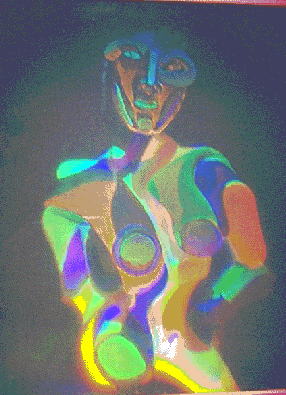
Primary Woman, by Lucas is part of a series, the first of which was Primary Man, a seminal piece, completed a year earlier. Perhaps this is fitting since the order is biblically correct. The edition was limited to 1000 pieces. Unlike Primary Man which was face only, Lucas sculpted the entire body using some of the vocabulary of Picasso, without imitating him. This
work is a fundamental study in colors and mixing and how to use them in
holography. Photographs or paintings cannot reproduce the colors that
can be produced by the hologram. They
are bright, luminous, and complementary chosen brilliantly by the artist
to make a striking, almost living, but stylized woman.
The plain black background emphasizes the richness and contrast
of color and the full contour of the body.
One can view this picture for a long time and continue to see
more and more new detail from different vantage points.
By
deliberately avoiding symmetry Lucas tells us much about her primary
woman. Notice that the woman supports most of her weight on her right
leg, hands on her hips, an artistic technique first employed by the
Greeks in sculpture, known as contrapose. This provides her a classic
confidence and determination in herself. Her left eye has a special ring
around it denoting some kind of special power. This eye directly feeds
the right brain, meaning that she has a special right brain perspective
of the world that dominates her left-brain. The special significance for
the right leg supports this theory. Primary
Woman's body has a split that runs from her crotch to her neck, a kind
of super vagina, illustrating sexual prowess in an abstract way. Much
abstract language adorns the figure, such as rings around the breasts,
which can be interpreted as shackles that bind her to her role as a
mother. There
are many advantages with the hologram over an actual sculpture, some
practical and some artistic. The hologram can hang on a flat wall and
create a useful space for the sculpture that does not exist in reality,
depicting color that never existed on a real model. The original
sculpture was always covered in portions of either black or white. The
colors are selected by the artist from an imaginary, boundless palette.
The original sculpture could be made of soft non-lasting materials,
freeing the artist from working in stone or clay. The
series represents some of the earliest art holography that successfully
employed a coloring procedure, developed in the early 80’s.
Color in holography is still more of an art than science, with
few artists having complete control. Holographic images of this type are
formed by reflecting light from layers in the photographic emulsion. The
color is determined by the separation of the layers. While a variety of
methods have been developed to adjust that separation and thereby add
color, this particular one employed an emulsion-swelling procedure that
is by no means simple chemistry. The model is first covered in black
with white added to a portion of it. An exposure is made then the
emulsion is swollen by soaking it in a chemical solution. That sets a
color for the portion of the model that is colored in white, while the
black is not recorded. The white is changed to a new part of the model
for subsequent exposures and new swelling amounts for different colors.
In principle, many colors could be added sequentially, but two or three
are the norm. Secondary colors emerge when two adjacent complementary
colors are mixed, so we also see greens, orange and purples. To
the trained eye, Primary Woman can be as mysterious as The Gioconda and
should be a lasting work taking an important place in art history.
Portraiture
and religion provided artists with patrons for centuries, serving as a
primary use, and moneymaking role.
Artists who could glorify the patron stayed fully booked.
Photography usurped the bulk of this role of the painter by the
end of the 19th century, though portraiture has continued as a major
moneymaking endeavor for artists. Those who can afford a painting
usually still choose that medium in many cases because the artist can
still provide a class not achievable by photography. Holography
is almost ideal for portraiture and yet its role continues to be
evasive. Monochrome,
holographic portraits are readily available at a price not much more
than a photographic portrait from a high-end photographer and about the
same as a painted portrait. Full color holographic portraiture is still
not available to the general public.
Portraiture is almost certain to become a primary use of
holography and it is truly amazing that this has not already happened.
Where else can one obtain an image as real as the actual person
staring from behind a window?
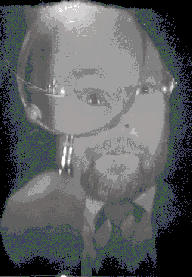
The
white-light-reconstructed image is bright and clear with a wide viewing
angle, excellent composition, color tuned to an amber-gray tint,
demonstrating his great skill with holography. The work displays
Boone’s fundamental knowledge of bleaching and use of film known only
to a handful in the world. He
exploits the dimensionality of holography further by holding a
magnifying glass before him, which extends in front of the hologram
plane. The viewer can
choose to study his face through the glass or around it. Here Boone metaphorically challenges the viewer to examine
him closely and judge whether he is a scientist, an artist, or both. The
magnifying glass in this self-portrait also symbolizes Boone's scrutiny
of the art world as well as those who refuse to acknowledge his work as
art. He has been verbal in his resentment that the art world seems to
accept as art only work created by "artists".
He frequently publishes his own critiques of the art world and
has published rules of art that include "A hologram by an artist is
not necessarily art," He
is quick to reprimand the often-used tact of artists who excuse poor
holography technology as the artist’s prerogative. Closer
examination of the hologram reveals a burn spot to the left of Boone's
face. This apparently occurred when the magnifying glass focused a part
of the laser beam into a high concentration of light, showing that this
commonly used "lens trick" in holography (to enhance the
parallax) can be dangerous to the eyes in portraiture.
Fortunately, the concentration of light missed his eyes,
hopefully by design. Holographic portraiture is definitely not for
amateurs. Boone
has been one of the most prolific holographic portrait artists in the
world working in a
university laboratory virtually next door to the Ghent Cathedral, in
Belgium, which houses Van Eyck's famous Ghent Altarpiece. He has
produced portraits of kings, queens, astronauts, AND……………this
critic. His work includes
other innovative ideas beyond portraiture as art. Having a Boone self-portrait in ones collection will some day
be likened to having a self-portrait of Rembrandt.
|