
Perils of a Plein Air Painter
The Italian Riviera
May, 2008
By James D. Trolinger
The Worlds Worst Tourist
Italian taxi's are expensive, even when the drivers are honest, and when they are not, which is often the case, they can mess up your whole day. I was delighted in Milan's Malpensa Airport when the young taxi driver changed my attitude towards Italian taxi drivers forever. I needed a ride to the Crowne Plaza where I would spend my first night before meeting up with the Tim Clark art group for our Italian Riviera painting trek. My research had told me that the short taxi ride should cost about 20 dollars, so I was ready to defend myself. Even though his English was almost non existent, after loading my bag and examining my hotel reservation for an address, he hesitated, pulled out his cell phone, and dialed a number that he got from the reservation sheet. After talking to the person who answered, he handed the phone to me, smiling, and said “Free ride!”. On the other end was the hotel manager who told me he would send a car to pick me up near the taxi stand. This one kind act improved my entire stay in Italy.
I met a tired, jet lagged group coming in from New York and half of them were dozing on the two hour bus trip to Camogli, where we would spend the next six nights, painting in and around the sea side villages of Camogli, San Fruttuoso and Vernazza.
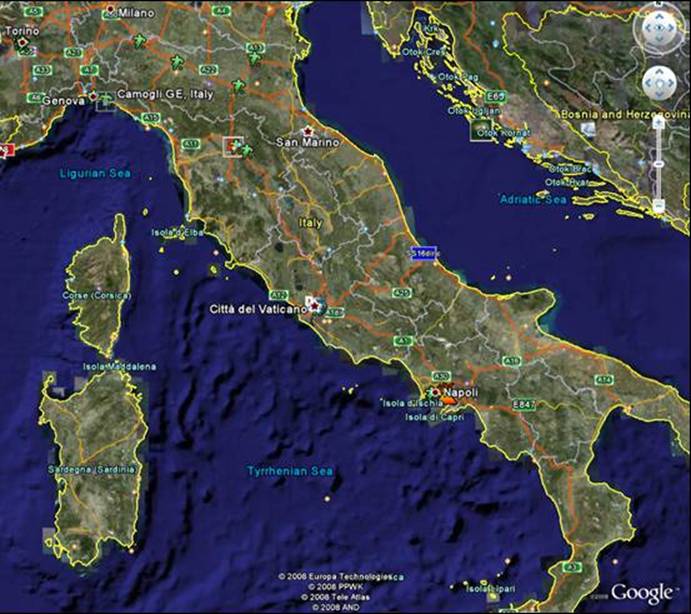
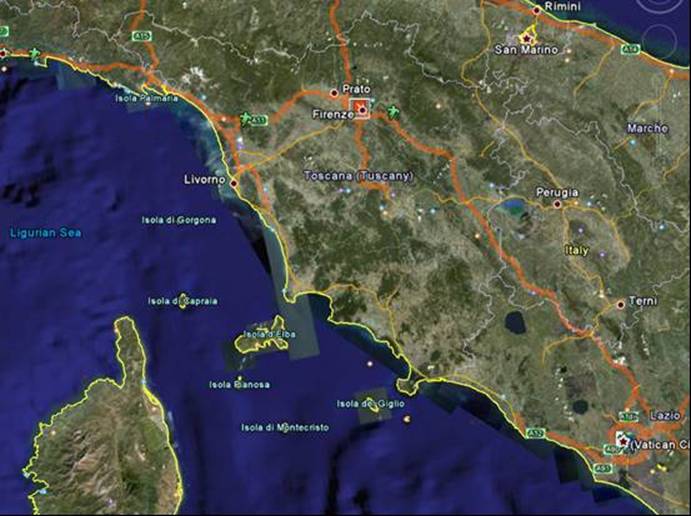
In spite of working with master artist, Tim Clark, in several work shops and classes before, I learned things about water color painting during this trip that left me wondering how I had ever painted a successful picture before. Only when one paints with a master like Tim can one begin to understand how beautifully complex and rich this medium can be and how much there is still left to learn. That delights me, because I enjoy knowing that most people creating watercolor paintings have little clue how to truly exploit this medium. It also tells me that I could spend the rest of my life and never run out of fun and useful things to learn about painting watercolor.
My first painting was the view to the north of the seaside hotel Cenobio Dei Dobi, where we stayed in Camogli. From here one has a beautiful view of the castle and the church. Tim chose the same subject for his demonstration the next day. After two more attempts incorporating what the demonstration had taught me I produced a piece that satisfied me.
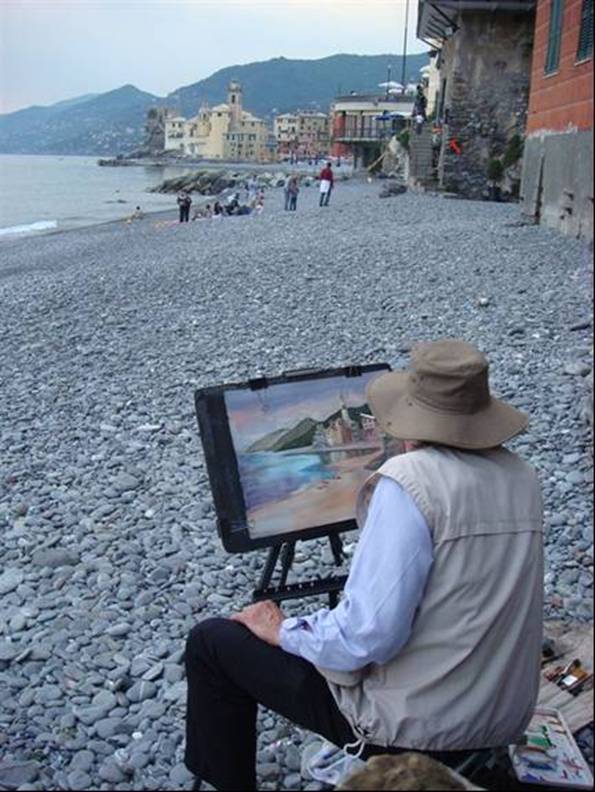
My first painting scene-Castle, Church, and Beach
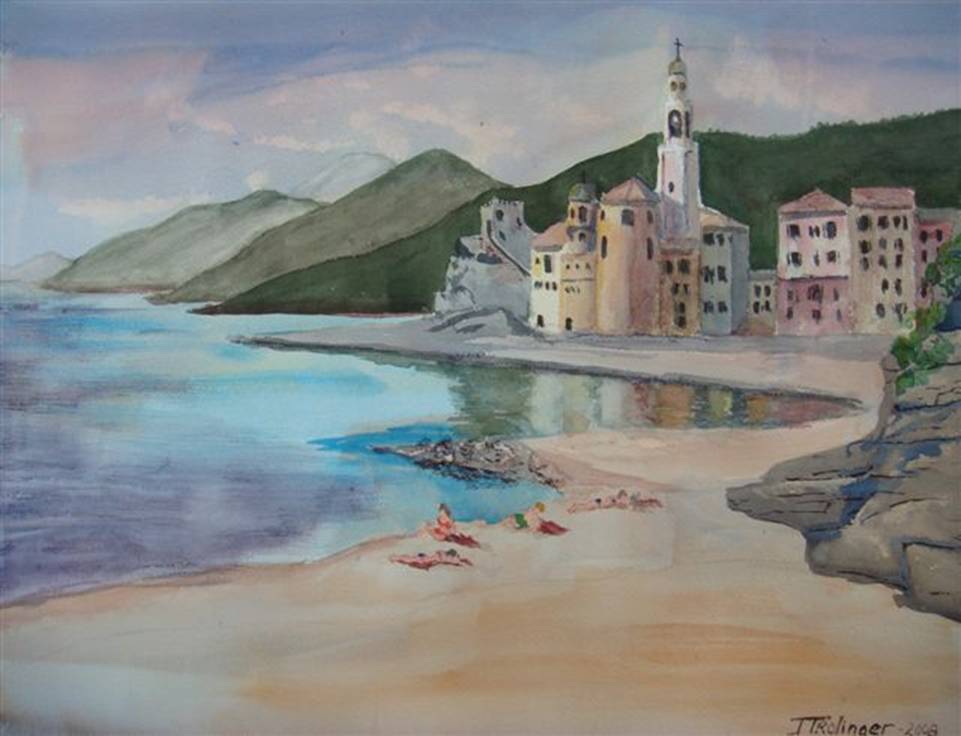
Camogli Church and Beach, 15”x22” watercolour on paper, painted on location in Camogli, Italy.
I would have been happy spending the whole 12 days in Camogli, even though a tour guidebook description as a sleepy fishing village has long since converted it to a tourist haven. Let's face it. There is no such thing as a sleepy fishing village or a secret village in Italy. The minute such a place is featured on television or in a major travel journal, it turns into tourist gridlock.
Nevertheless, Camogli is artist friendly because it has many beautiful painting scenes that are relatively free of tourists in the early morning and late afternoon, the best times to paint. There was plenty of room on the beach, at least when I started, and fitting in among the sunbathers, dealing with sunburn, gawkers who want to talk, and the rapidly changing light patterns were only the first of challenges. By the time I was well into painting I couldn't help being a bit distracted by the beautiful Italian women in bikinis that were designed to cover as little as possible. Then with a glance to my immediate left I saw that I was wrong about how little could be covered, and the distraction got a bit overwhelming. It was then that I realized how tough plein air painting in Italy was going to be. But, I figured, somehow I would get through this.
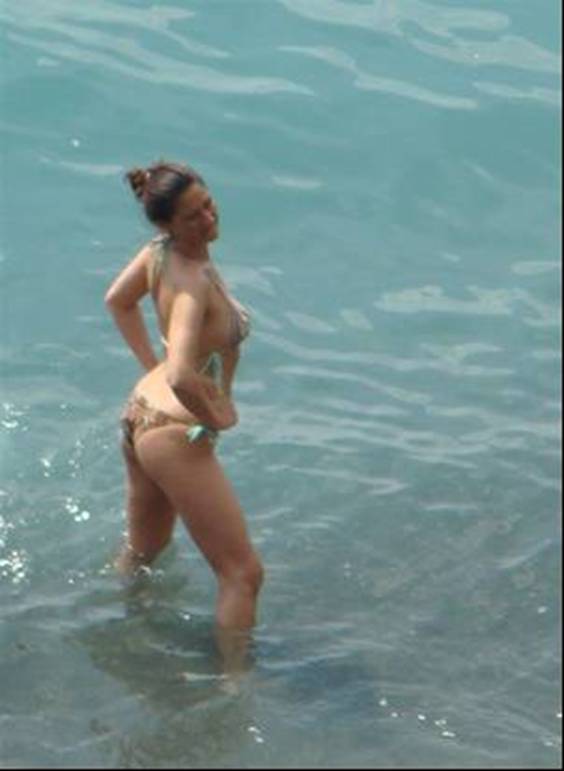
Bikinis are designed to be invisible.
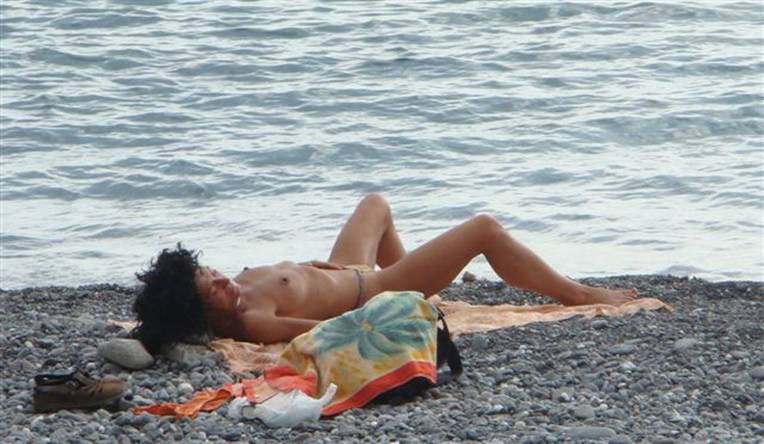
And then you discover the bikini becomes even more invisible.
After eight hours of painting, and having something I felt worthy of keeping I returned to the Hotel where I was greeted by an enthusiastic Zeke, my room mate. Zeke was delighted that I had returned before the sun had set, because he wanted to show me the sunlit view of the pool and sea from our room.
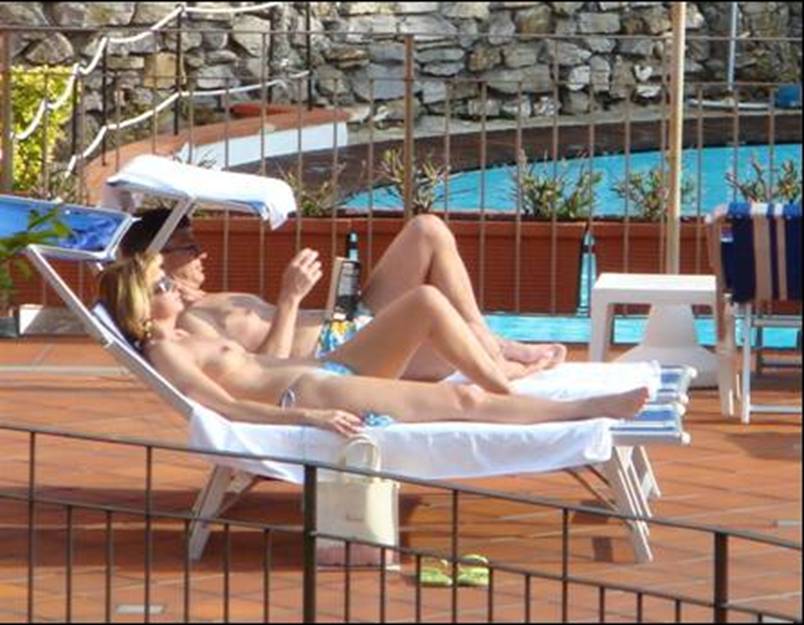
View of the pool from our hotel room. Sometimes the view was blocked by sunbathers. The sea is to the right of the rock wall in the background, outside the field of view of the camera.
By the weekend Camogli was overrun with tourists coming for the annual sacred fish festival, Sagra del pesce, something like Mardi Gras with fireworks, parades and bonfires. On Saturday, the local fishermen cooked free fish for everyone in a huge, 20 foot diameter skillet.
For the rest of the trip most of us painted in the early morning and late afternoon and joined in with the rest of the tourists in the mid days, since regardless of what you chose to paint, all you could see were tourists during peak hours.
We spent a day painting boats. Tourists and the distractions mentioned above are just a few of the challenges to a plein air painter. Just as you get in to painting a boat, someone moves it……..or it rains. But the Italians were nice to us. I understood little of what they said to us, but I could understand the words “Bella Bella”, which we heard often, even when I thought the painting was not “bella”. Tim had once commented that he keeps gawkers from bothering him by keeping his painting ugly as long as possible. As Tim made his rounds assessing everyone's boat painting he commented that my boat was lacking color and places were begging for shadows; I had been saving this part for last, and I responded by telling him I was working on keeping my painting ugly as long as possible, as he had advised, to keep the gawkers at bay.
At this spot in the Embarcadero I found a great painting spot that I could squeeze into that shielded me from the tourists, so I stayed and painted finished the painting, even after some pecker head came and moved one of the boats I was painting.
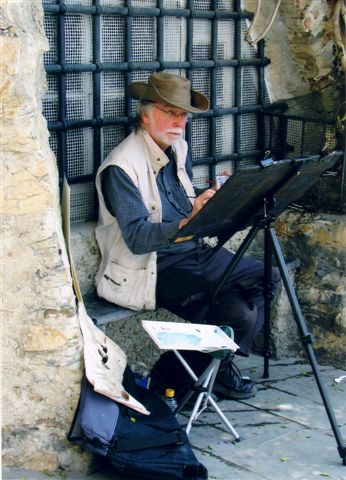
A convenient spot that got me out of the line of tourist fire-Photo Courtesy of Helen Ryhlick
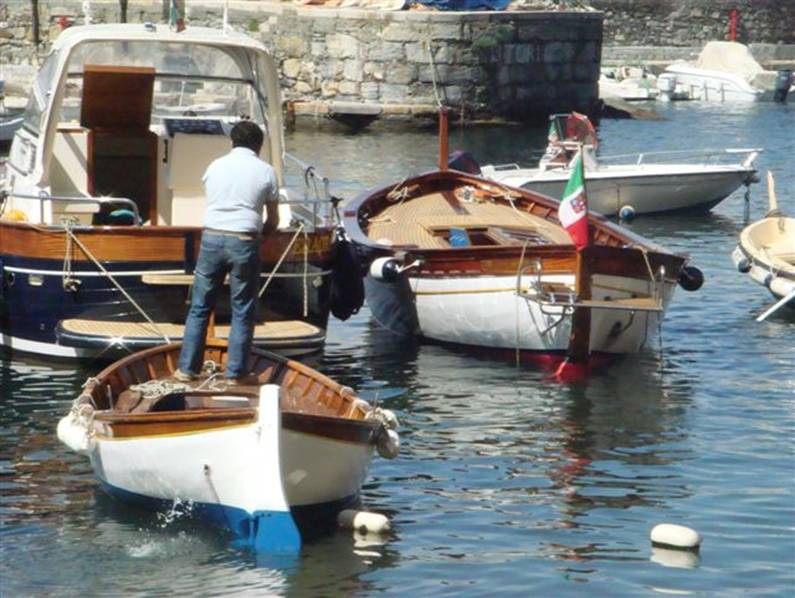
Senore!!! Please don't move that boat. I am painting it.
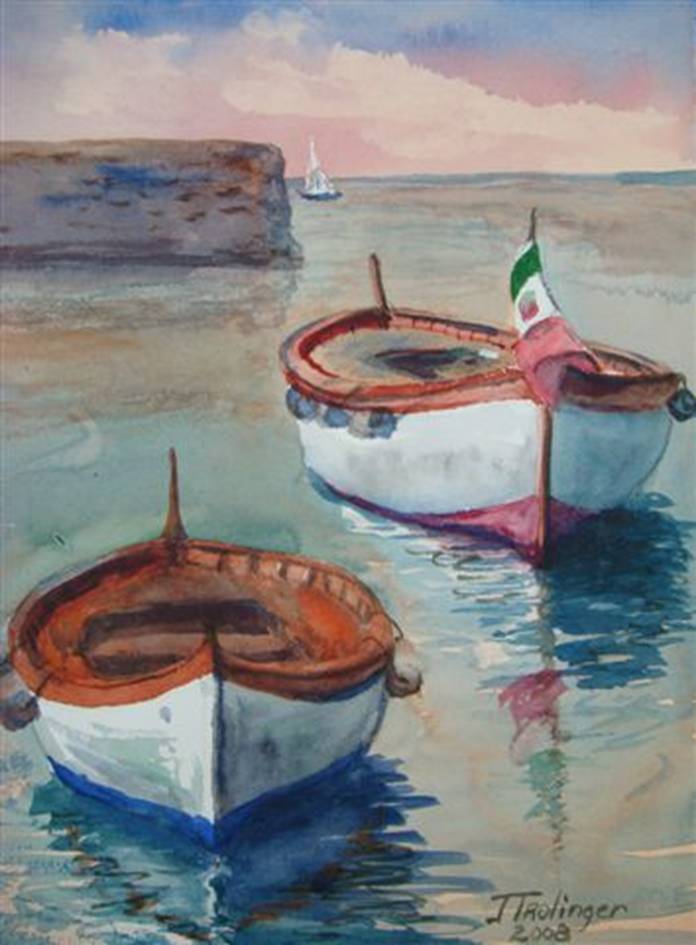
Camogli Embarcadero, 11”x15”, Watercolor on paper, painted on location in Camogli, Italy.
Our next distraction was an Italian rail strike that forced us to delay a day trip to nearby Vernazza. The first and only time I have ever been totally overwhelmed in plein air painting took place in the village of San Fruttuoso, a “hidden, secret” village that is accessible only by boat. The experience was surreal. This trip, originally planned for a Sunday, was moved up to Friday because of the rail strike, since there was no boat strike.
The abbey at San Fruttuoso dates back over 1000 years and houses the remains of St. Fruttuoso and two other martyrs. No one knows how his remains wound up here; however, tradition has it that the saint, martyred in the year 259 gave instructions to his disciples in a dream. This village has been in the noble Doria family since 1200 (They owned the ship Andrea Doria, which sank in 1956, killing 55 people.), and they have provided funds for its improvement and upkeep.
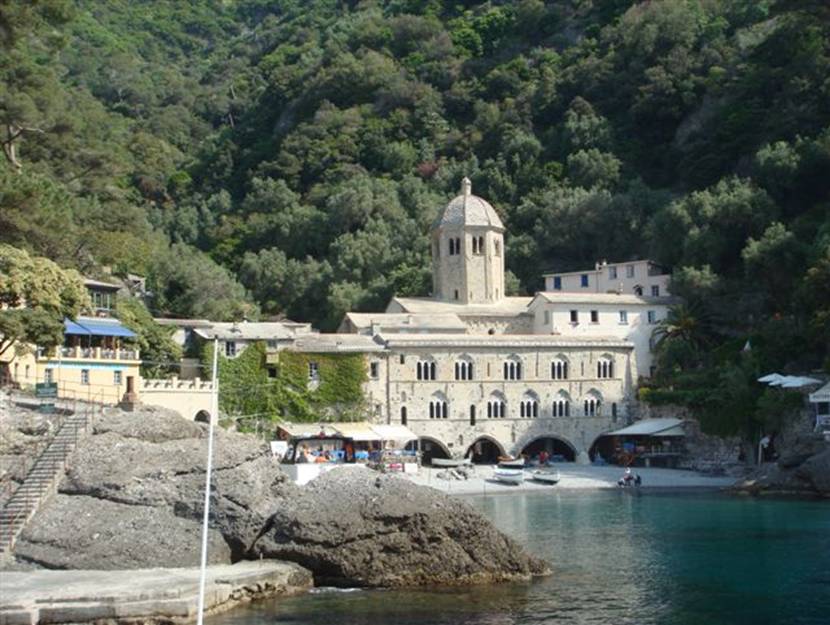
San Fruttuoso at 9 AM-We had it to ourselves.
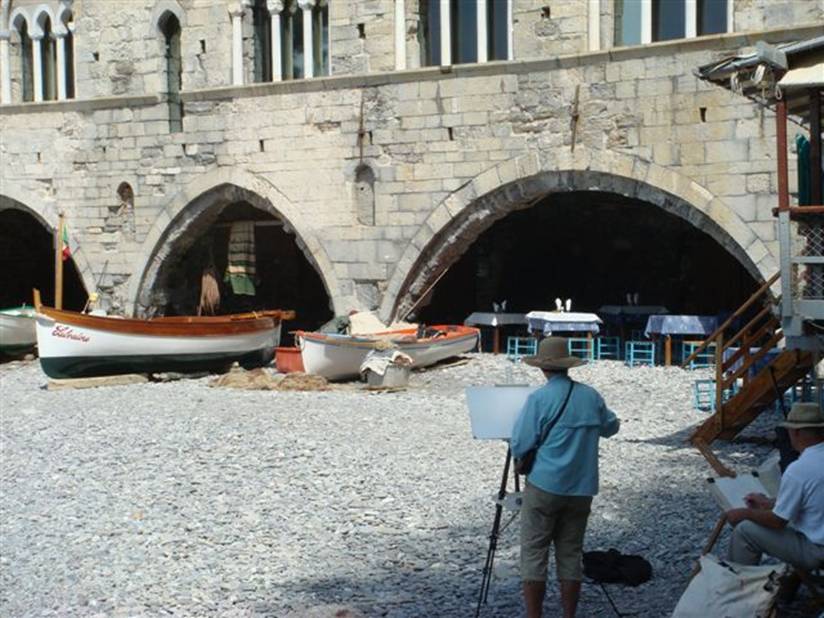
Painting the San Fruttuoso Abbey at 10 AM
We realized that our secret haven was not so secret when the first boat of school kids arrived at around 11 AM. Then, like a D-Day invasion, wave after wave of boats arrived, unloading hundreds of school kids, who eventually were almost shoulder to shoulder on the tiny beach. The noise level reached 100 db with kids stumbling over the rocks, backing into easels and stepping into paint boxes. As with any kids packed into a small area with nothing to do, they began inventing entertainments, like goosing each other, wrestling, throwing water, then rocks. It is hard to imagine why they bring so many kids to such a place. We surmised that the very influential Doria family may encourage this as a way to keep the Doria family in the minds of future Italian leaders. Eventually we established a defensive beachhead against a cliff and had our picnic lunch packed into a corner of the beach.
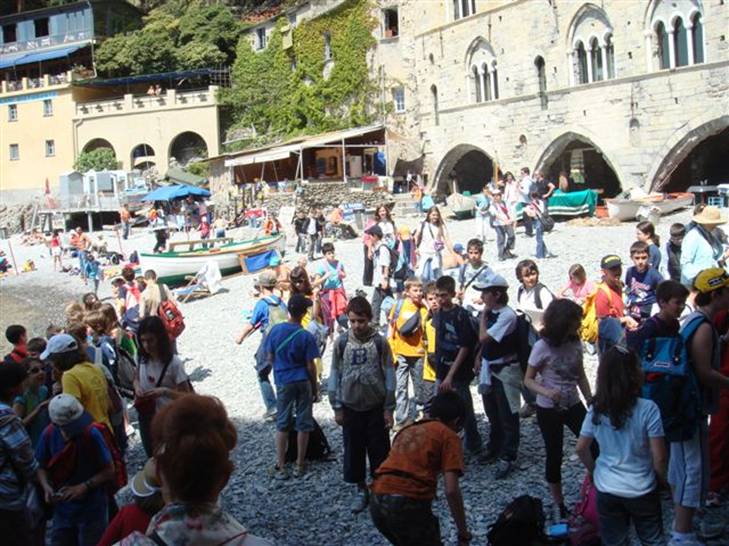
Waves of Boats Bearing School Kids Invade the Village
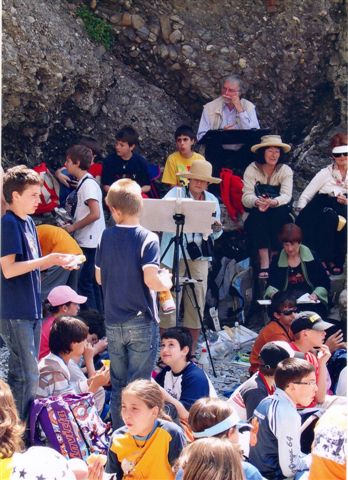
San Fruttuoso, the secret, hidden, Italian seaside village-Photo by Helen Ryhlick
In spite of the challenges some great paintings were at least partially created in San Fruttuoso and completed later. Ruth Baderian was one of the artists who faced yet another plein air peril. Just as she had started the painting of the boats near the abbey and as the invasion began, the boat owners, out of defense began covering the boats. Fortunately she had taken digital photographs that she could use to finish the painting later. Judging from the result, I would say she managed quite handily to overcome the perils.
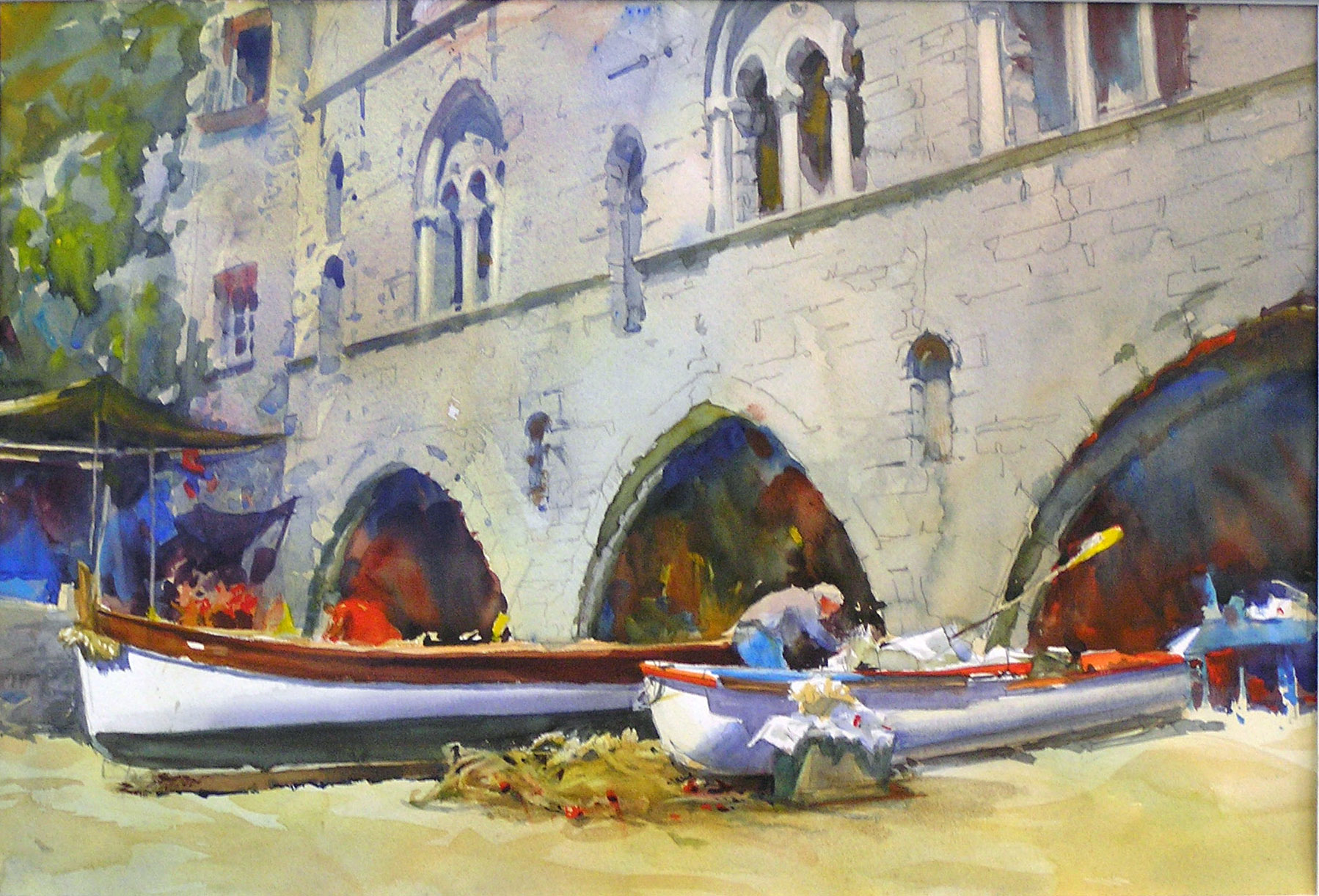
San Fruttuoso, by Ruth Baderian, watercolor on paper, started on location.
After a couple of hours, all but a few die hards gave up, and I decided to spend the remaining time by walking up to the abbey. To my great surprise I found a quiet spot with an unusual view of the front of the abbey. I had less than half an hour left, but I couldn't resist starting a new painting.

Finally a quiet spot with a view I could paint and a half an hour left.
I couldn't turn down what the universe had provided. The room directly in front of me is a chapel with incredible acoustics. I watched Tim and Zeke enter; They had not seen me yet. Tim began to test the acoustics by singing. I think you could have heard him back in Camogli. I finished a quick drawing and began to wash in a sky as Tim and Zeke reappeared and saw where I was sitting. "Could you hear us?" Tim asked.
"Hell! Everyone in the world heard you," I answered.
Looking at what I was doing, Tim commented, "That is quite risky perspective you are attempting, but I think it can work out if you are really careful." Then he told me what I didn't want to hear. "It is time to go. If you miss this boat there is one other one in a few hours, but don't miss that one."
I'll catch up with you; I just need a few more minutes," I responded. I made a few notes, lots of photographs, dabbed on a few more bits of paint, packed up, and ran for the boat, which was already loading passengers.
I forgot all about the painting until a couple of months later when I rediscovered it. As I looked at it, all the memories and sounds began filling my brain again. I could even hear Tim singing in the chapel and feel the anxiety of running for the boat. Even though the painting was far from complete, I could feel the spirit in the painting as I finished it, not the same as being there but infinitely better than copying from a photograph.
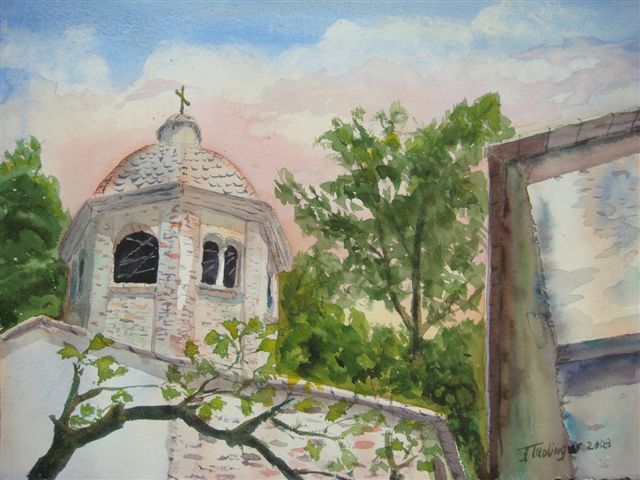
San Fruttuoso, 11x15 Watercolor, started on location in Italy and finished later. Exercising artistic prerogative I moved the tree in the foreground, lost the wires, gutter, and light, and invented a sky.
On Sunday, with the rail strike not a threat, we went to the village of Vernazza, one of Cinque Terra (Five Villages), a national park on the coast. Vernazza brought on a few new and totally unexpected plein air perils.
Tim took me aside for some advanced mentoring. While my painting has definitely improved over the years, I still get critiqued routinely (not just by Tim) for painting more like a scientist than an artist. I become too involved with the scene, too worried about details in the scene. I get accused, with some justification, of painting all the windows and door knobs and forgetting to concentrate on making a beautiful painting. “You are not painting that dog. You are painting a painting. There is a big difference. Don't allow the subject to control your painting. You are the artist and you must control the painting.” Having become frustrated with my failure to paint more like an artist, he likened my situation to a well laid floor. His belief is that I will not be able to lay the “artist floor” on top of the scientist floor and expect it to work well. “You have to strip away all of the old layers built up over your entire career, all the way down to the foundation, and then begin laying the beautiful Italian tile floor. With this advice I searched for a scene that would inspire me to create an artist's painting and not one that I could simply paint, i.e. paint a painting, not a scene.
This turned out to be a very agonizing process as I wandered around sketching and looking for the magic, inspiring scene. After nearly two hours of indecision and at least twenty sketches that had yet to inspire me, I was nearing the point of giving up when another of the other perils of plein air painting hit me; I realized that I was about to explode, since I hadn't had a pee since we left Camogli. Vernazza does not have a single public toilet (outside the station, which was a long hike), regardless of the hoards of tourists who flow through the place. With not even a McDonald's I cannot imagine where everyone pees. After failing to find a public toilet anywhere I ordered a cappuccino in the closest deli and headed immediately for the loo. I hesitated to drink the cappuccino since it would make me need the loo again, but it was soooo good. Next I ventured to a corner in the square and sat on a bench to see if my inspiration had changed.
Suddenly I heard Zeke screaming in agony from one of the nearby painting locations. He had located a prime spot beneath a ledge and in the shadow of the church overlooking a group of boats. As he was putting the finishing touches on a very nice boat painting, the ultimate, dreaded plein air peril struck. A bird (Zeke swears it was a condor.) unloaded an unbelievable volume of something that rhymes with direct hit on Zeke's location, covering both he and his painting with a blend of white and yellow stuff. Watercolor purists dislike white paint, and this form of white is the ultimate bad white. Since he spent the remaining time washing clothes and art equipment, Zeke's artistic inspiration waned for the rest of the day.
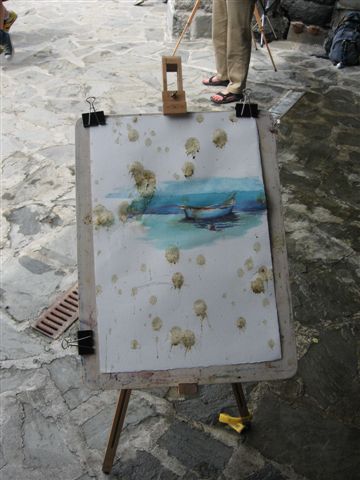
Zeke's boat painting after taking a direct hit with the plein air painter's worst nightmare
I am not sure if seeing Zeke in worse agony than me or the cappuccino kicking in helped, but suddenly a scene with all the elements of a good painting appeared before me. Within an hour I was on my way to freedom. Somehow I had reached the flooring foundation, and I began liking what I saw. One learns to anticipate how the suns movement will change not only shadows but also other parts of the scene and paints accordingly. I anticipated that the two orange umbrellas would soon be opened up. I was right. Even so, the space between me and the scene soon became so filled with noisy Germans that I began losing my inspiration. Since the time to leave was nearing, I folded up an incomplete, but satisfying work of art. This probably also saved me from continuing on to add details that would have screwed up the painting. For the first time ever Tim, upon examining the painting, commented that it looked like a painting done by an artist.
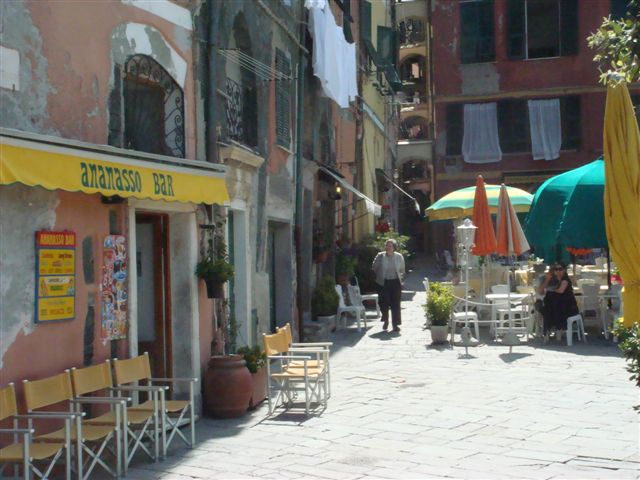
My little corner of Vernazza-The four arches with varying height captured my interest. I anticipated that the orange umbrellas would be opened before I finished painting the scene.
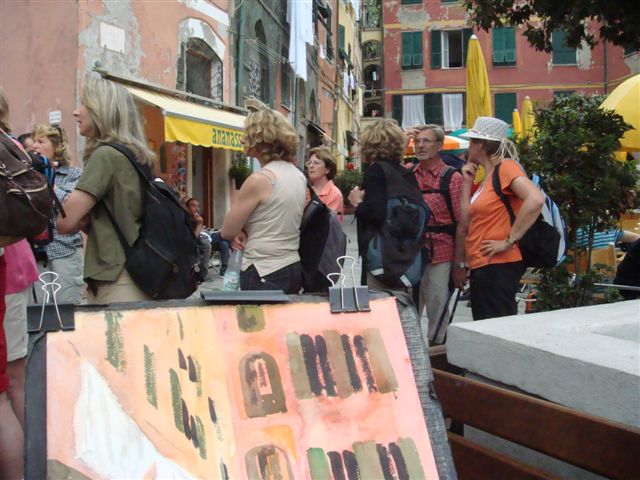
The Germans invade my little corner. Notice the umbrellas are now open.
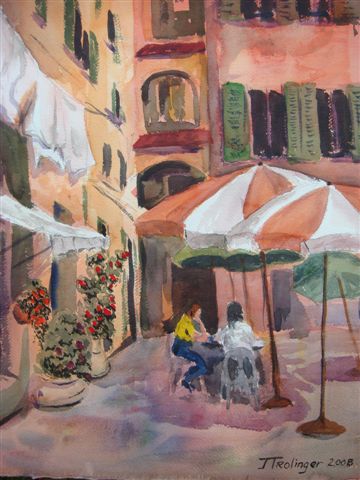
Vernazza Café, 15”x22” Watercolor on paper, painted on location in Vernazza, Italy
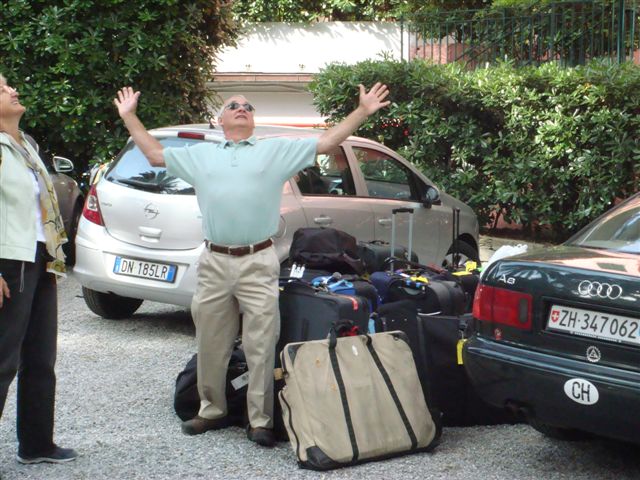
Zeke, having been able to wash most of the birdshit off his boat painting, is newly inspired and shouts, “Here I am, you birds. Bring it on!” Hilde looks on to make sure that it is Zeke they're after.
From Camogli we moved on to Lucca for two days, stopping for a few hours to visit Pisa, its Basilica, the Baptistery, and the tower of Pisa. In the Basilica is the famous Galileo chandelier that he is said to have observed and timed with his heartbeat, giving him the basis for important equations of motion. Though he is said to have dropped a cannon ball and a rifle shot from the tower to study gravity, many historians doubt it. Many of the Galileo stories have been declared mythical in recent years, perhaps the most prevalent one being his mistreatment by the church. It seems that the church was not refuting him for his work in science; they fully supported it. They simply wanted him to stop making religious proclamations for which he clearly was not qualified.
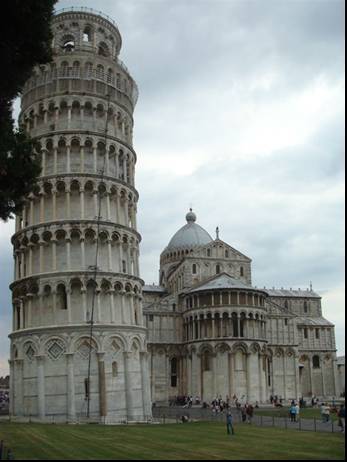
Leaning Tower of Pisa
Tim arranged for a young lady to demonstrate the incredible acoustics of the baptistery by performing a chant. All the doors were closed and a dead silence fell upon the room. She sang an extremely emotional chant that reverberated and added harmony and beat notes to her real time melody. When she finally stopped, turned and walked away, the sound continued to reverberate for a full ten seconds after she had left. I walked from the building with a huge lump in my throat and a tear in my eye hoping that no one would approach me and expect me to speak. I am sure I would have broken into tears with the slightest of stimulus.
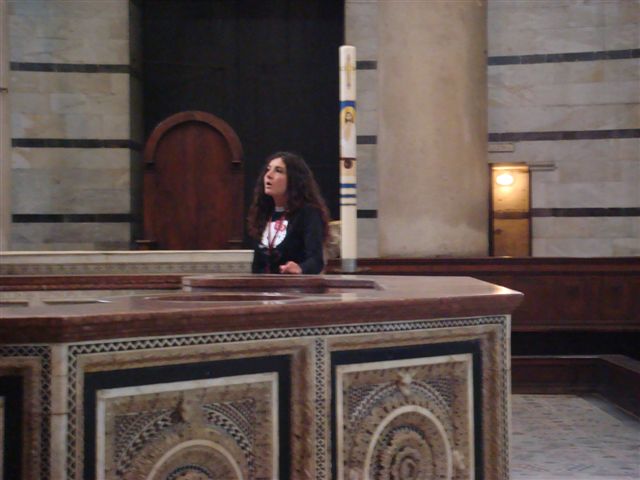
Chanting in the Pisa baptistery. The sound continued to reverberate long after the young lady left the platform.
Lucca is a wonderful old city surrounded by a two and a half mile wall that we walked to pick out painting sites. As in all the cities it has many great churches.
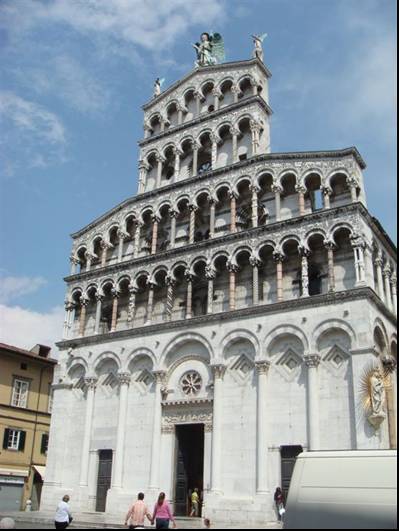
St. Michelle Church in Lucca
It is hard to imagine anything blocking a plein air scene completely. It happened to me in Erlangen, Germany once when a large truck pulled up immediately in front of me, and the driver even asked me to move. As Tim got half way through a demonstration a movie crew that was to shoot a special film on a famous singer, Puccini, who was born in Lucca, moved two large trucks directly in front of the scene, blocking it entirely. Fortunately, he had made a digital photograph of the scene that he could use to finish it. This pointed out the importance of shooting the photo before beginning the painting.
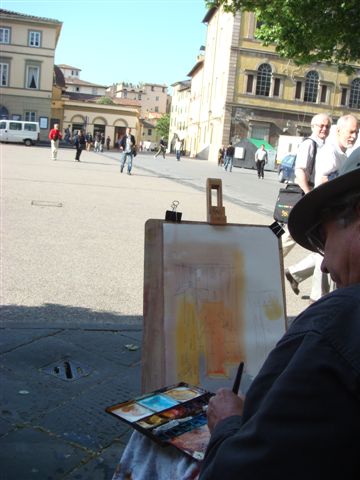
Piazza Giglio in front of our Hotel UniversoBeginning of a demonstration. Half way through the demonstration a movie crew moves in to completely block the scene.
Zeke and I moved on to paint for the rest of the morning in the Piazza Antelminelli. Near the hotel, this delightful, quiet and peaceful plaza, featured two major benefits, perfect lighting few and tourists. We were soon joined by an English artist who apparently liked the scene and wanted our company as well.
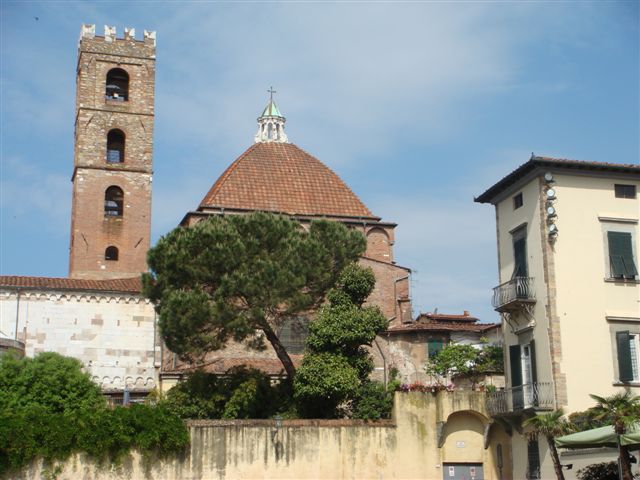
Piazza Antelminelli-One of many beautiful painting sites in Lucca. This scene needed some compositional changes. The tree should not stop exactly at the roof line, and it should be leaning in the opposite direction. No problem for an artist.
After a critique and a picnic lunch back in Piazza Giglio, Tim, Zeke, and I agreed to paint together in the afternoon, and we began a search for the perfect scene. First we returned to the Piazza Antelminelli. The lighting was no longer optimum for the scene we had started in the morning, and the correctly lit views failed to “blow anyone's skirt up” so we continued on. Now everyone became picky over which scene would qualify. Some had too much sun, some too hot, some too many tourists, and so on. In fact, we passed up a dozen magnificent scenes. After walking for at least a mile with no scene that suited everyone's taste, Tim's eyes lit up as we passed through a narrow alley. “I am going to paint that bicycle!” he said excitedly. I have often been amazed at Tim's choice of painting scene only to be further amazed at the beautiful painting that emerges out of something that I would not have looked at twice. This one took the cake. Against a wall partially hidden by a half open garbage can and a pile of street signs was a bicycle that had seen better days. Zeke and I looked at each other in amazement and we both broke into laughter.
“Why are you laughing?” Tim queried. I responded between gasps of laughter. “We have walked all over this beautiful city and passed up dozens of beautiful scenes, and you pick a bicycle sitting amongst a pile of trash to paint.” I had not realized that Tim was serious. He had not seen the pile of trash. He only saw the beautiful bicycle.
“I could make a beautiful painting of that.” he insisted.
“I am sure you can. So you paint that and I am going back into Saint Michelle Square.” But I had ruined it for him by calling his attention to the trash, and he refused to stay and paint the bicycle. We all continued back to Piazza Giusto, which was beside our hotel; we had come full circle. Here I saw another beautiful scene and I anticipated that it would have perfect lighting in a couple of hours. As I painted, two little Italian boys stood by me and insisted on trying out what little English they knew. Every time I acknowledged their “Hello. What is your name?”, they laughed out loudly, and we gave each other high fives. In fact, it helped me with the painting, since each time I responded and kidded with them, the painting would have time to dry just the right amount. I was in no rush. To make the scene even more perfect, just as I was completing the painting five hours later, as often happens, God added something to the scene for me that I really liked. Someone parked a bike in the perfect spot, so in honor of Tim I added the bike to my painting. To add something to the composition, I moved a leaning tree that was to the left of the scene to replace the straight tree in the real scene. Only later did I realize that I would have to guess where the shadow would have been if the tree had really been where I painted it. But it turned out to be a more interesting shadow anyway.
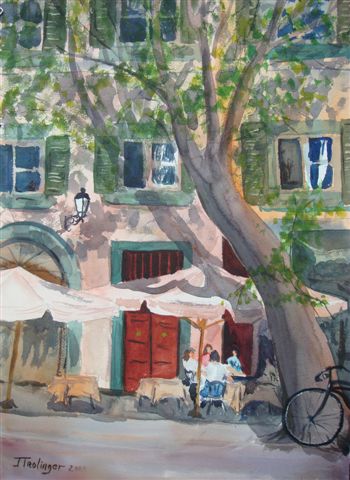
Lucca Street Café, 15”x22”, watercolour on paper, painted on location in Lucca, Italy.
Shortly after leaving Lucca our bus passed within view of Florence, home of our bus driver. He commented on Florence, saying that people in the North of Italy hate those in the south while those in the south hate the northerners. Then he added, “Those in the central part hate everybody.” He discussed Donnatello and Bruneleski leaving Florence after Gaberti won the contract to sculpt the famous baptistery doors in Florence. It took them 22 days to walk to Rome. The same trip for us was less than two hours.
Before reaching Rome we visited the walled city of Orvieto, high on a mountaintop. The entire city could be a painting site, and the church at the highest part of the city is spectacular. Fortunately, like in Lucca, tour buses cannot come into the city and in Orvieto tourists have to access the city by funicular so there are fewer of them.
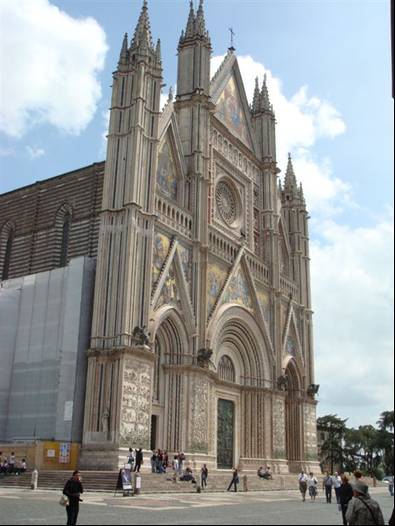
Church in Orvieto.
The façade of this church has the most amazing sculpture.
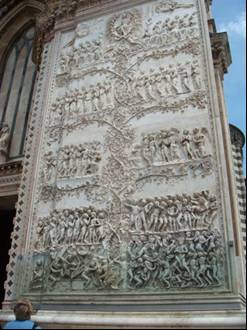
Facade
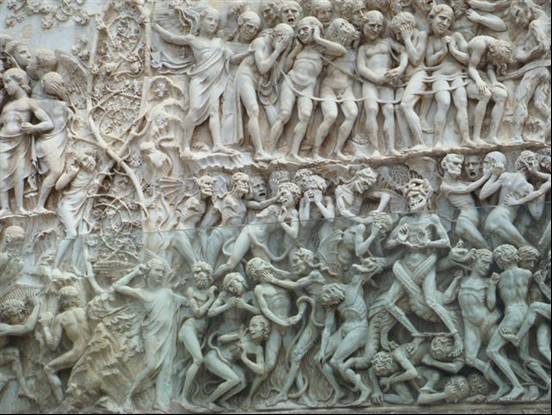
Façade Detail
We went on by bus to Rome and spent the last three days in Grand Hotel Minerva on Piazza Minerva next to the Pantheon, the second largest dome in the world, an almost perfect location that allowed us to walk around the most interesting part of Rome. (If you check this hotel's web site you will see that the lowest, discounted price for a double room here is over $600, setting a new hotel price record for the WWT.)
Since my main goal was painting, there was more than enough within walking distance for tourist time so I painted in the early mornings and walked around in the afternoons.
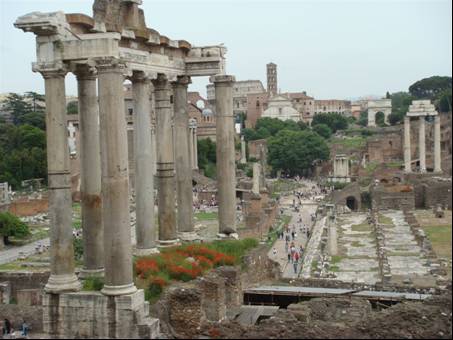
Ancient Roman Ruins
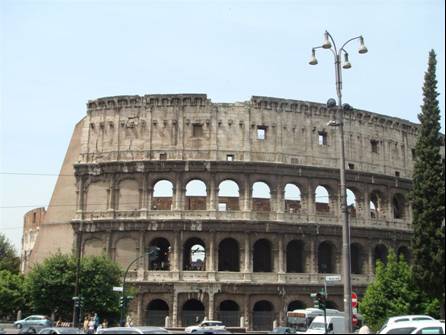
Coliseum
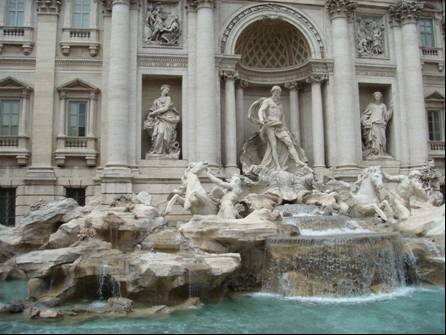
Trevi Fountain (Of Three coins in a Fountain Fame)
For my last painting I selected a pair of domes in Navona Square with a sky background. Here came one of the perils and delights of plein air painting producing a near mystical experience. I was experimenting with the sky. Watercolor always has a bit of unpredictability about it, which is one of its delights. The paint began to run and spread producing a rather spectacular, but, I thought, also unnatural, effect. I considered washing it off and starting it over, when suddenly I realized that a cloud had moved in and the real sky seemed to be imitating my painting. Tim commented from behind, “That is the most spectacular sky I have seen you paint.” Suddenly it rained for about thirty seconds, my painting took a few hits, then we had blue sky again. Everyone who saw the painting really liked the sky, including me, so I left it as was, even though it looks rather unreal. I began to realize what is meant when artists say “paint the painting and not the scene.” I figured someone besides Tim must be helping me with my art. The scene seemed to be imitating the painting.
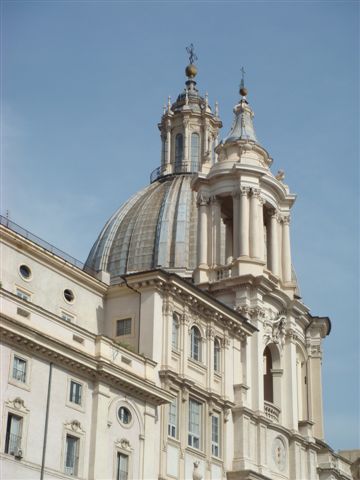
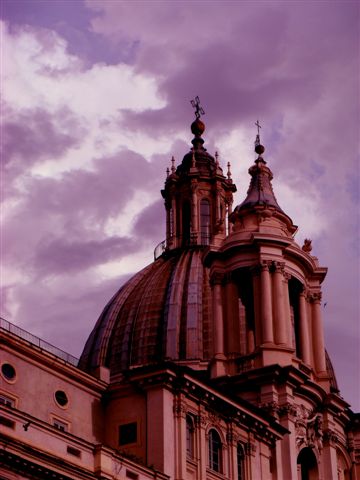
Cupola scene in Piazza Navona before and after the cloud came over
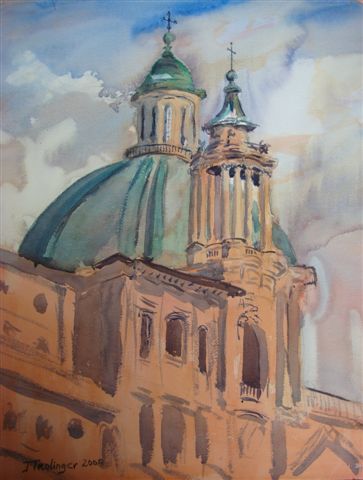
Piazza Navona, 15”x22”, Watercolor on paper, painted on location in Rome
Why do we do it?
Why do we choose to sit in the cold, hot, rain, dust, sand, tourists, bugs, mosquitoes, and bird shit when we could take a photograph and sit in a nice air conditioned studio and paint from the photograph (which is infinitely easier)? Because every plein air painter knows that this is the only way an artist can put his entire soul and the soul of the environment into a painting-That's why. When you sit with a canvas before a scene and smell the air, listen to the sounds, experience the dynamics of the moving shadows and the changing scene, you go into a trance and become one with the scene. As the painting develops you experience emotions that could never happen with a photograph, and you can put energy and spirit into a painting that doesn't exist in a studio. The emotions are not only higher but are measured against lower lows pushing them to an extreme. Failures are complete unrecoverable disasters and successes have an unexplainable energy, excitement, and usually an unforgettable story to go with them. For similar reasons athletes run their best (and worst) race during the Olympics, and pianists play their best (and worst) before an audience. If you have a plein air painting on your wall, you have something very unique and special. It has spirit, energy, and substance that is not present in a studio-created copy of a photo. Your painting sat with the artist for hours before the scene it represents. The artist most likely cussed it, cried over it, and ultimately loved it. And it most likely contains (in addition to paint) bits of the actual environment like sand, dust, bugs, rain drops, sweat, and maybe even some bird shit. If you want the ultimate in art, hold out for a plein air painting.
We end our painting treks with song and poetry to describe some of the trials, tribulations, and delights of plein air painting. In Venice we called ourselves the Fabulosos. In Rome we elected to call ourselves the Fabulous Capa Tostas. (Capa Tosta is Italian for hardhead.)
Here are a few verses.
Chorus
Oh yeah, Oh yeah
Don't be a Capa Tosta
Keep your friends near and drink lots of beer
And don't be a Capa Tosta
Verses
Zeke went to paint for about an hour
And when he came back he needed a shower
but he's not a Capa Tosta
I painted all week until it hurt
And tonight I'm wearing my cleanest dirty shirt
And I ain't a Capa Tosta
Betty loves those Italian fellows
Especially when she's had a few limoncellos
And she ain't a Capa Tosta
(We teased Betty about a love affair she had with an Italian drink named limoncella)
Jim went away from the rest of the class
And all he could paint was a German's ass
But he ain't a Capa Tosta
To make David behave the way he should
He brought along a lady named Puud
So he won't be a Capa Tosta
(David's wife's nickname is Puud)
Tim wanted to paint a bicyclecha
But Zeke and Jim said we ain't gonna letcha
And we ain't Capa Tostas.
Load up your gear and listen up men,
Painting here's a challenge but we're going in,
Cause we aren't Capa Tostas
We had created a few more verses that got censored.
Later Ruth Baderian submitted the following verses:
We schlepped in the rain for our Airport bus
But not one of us painters made a fuss.
Cause We're not Capa Tostas
Ate salami and cheese on a secret beach
Cause it was too crowded for Tim to teach
He's not a Capa Tosta
In Lucca,"At Last, a paintable site' said Tim
Until the movie trucks covered it up on him.
Now they are Capa Tostas